
Exceptional Opportunity to Get Involved to Foster Growth & Community

American Indian Higher Education Commotion - AIHEC
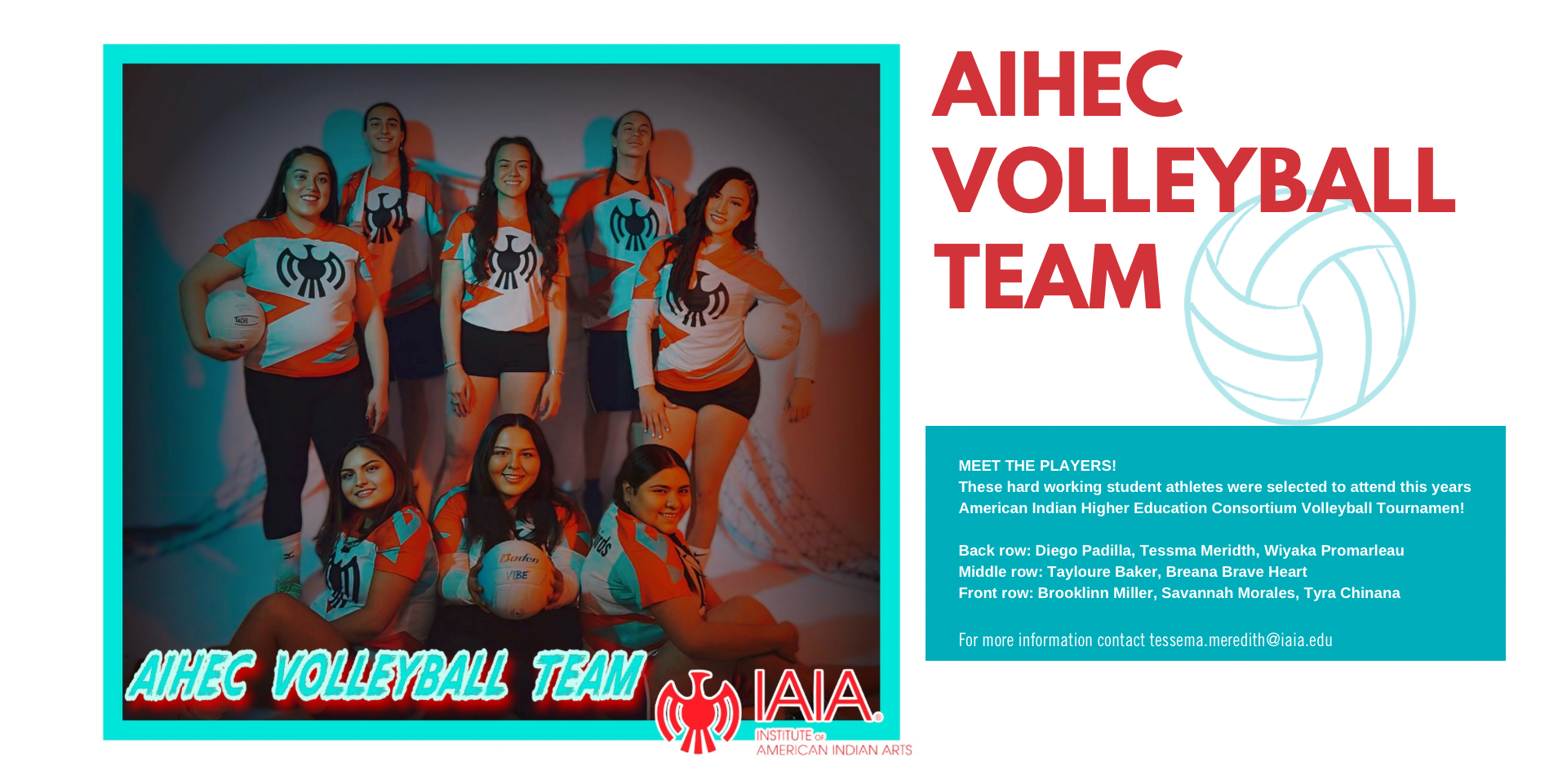
Since the first AIHEC Student Conference in 1980, this annual event has grown from a few dozen participants to over 1,000 students, faculty, and staff coming together each spring to compete in academic, cultural, and artistic exercises; share stories, and best practices; participate in workshops and plenary sessions; and celebrate the Tribal College Movement. As participation has grown, the conference has also grown in complexity and organization. In 2010, the AIHEC Board of Directors, composed of the nation’s Tribal College and University (TCU) presidents, requested that AIHEC and TCU staff begin the process of formalizing and standardizing the conference, including competition rules, participation requirements, judging, cost, etc. In 2013, the Board established the AIHEC Student Conference Commission to oversee this process.
-
AIHEC Volleyball Competition Rules
The net height is set at 8 feet.
Only the team captains may address questions concerning a player, the game, or an official’s call.
Non-athletic shoes and any item an official or coordinator feels may be a risk are not permitted to be worn during competition.
A team consists of eight (8) players with no more than six (6) on the court during the game. A game may start with as little as only four (4) players (one (1) male and three (3) females).
Free substitutions are allowed during dead-ball moments.
A match is considered the best of three (3) games.
The first two (2) games will be played to twenty-five (25) points each game, using rally scoring. The third game will be rallying scoring to fifteen (15) points.
To win games, teams shall win by two (2) points or the first team to score thirty-one (31) points in the first and second game or twenty-one (21) points in the third and final game.
At least two (2) males and two (2) females are required to start a match. There can never be more males than females on the court for a team. Teams can play with as many as four (4) females and two (2) males.
Game time is grace time. A team that does not show up after fifteen (15) minutes will forfeit the match to the present team.
Teams are provided one (1), sixty (60) seconds, team timeout per match.
All rosters are final after the first game.
Awards will be given to 1st, 2nd, and 3rd place teams. Awards will be given to only eight (8) players and one (1) coach per team.
Volleyball Competition Guidelines & Procedures:
The Volleyball coordinator is chosen by the host committee. The Volleyball coordinator will reserve at least one appropriately-sized gym with boundary lines marked for regulation Volleyball.
The Volleyball coordinator will provide periodic updates to the host committee concerning registration numbers and the cost of the Volleyball supplies (nets and volleyballs).
If enough resources (equipment, officials, gym-size, etc.) can be secured to play four (4) matches at once, then double elimination bracketing may occur.
The Volleyball coordinator may use the proven rules from above and adjust as the need arises to adapt to the specific host location, participant-entry size, budget limitations, etc.
The Volleyball coordinator might need to recruit ~ four (4) people (faculty, staff, or students) to assist with officiating, monitoring, scheduling, and on-site setup of the Volleyball courts in the gym. For two (2) matches to be played at once, two (2) people will be needed to officiate (one (1) per court) while four (4) people will be needed as line judges (two (2) per court).
Depending on the budget available and the policies of the host committee colleges, the coordinator may wish to: charge an entry fee, hire professional officials, and/or hire an athletic trainer.
Suggested Checklist of Materials to bring to the conference for two (2)-court, single elimination matches: two (2) eight (8) foot nets; four (4) Volleyballs, eight (8) small plastic cones to determine the back lines, large dry erase board to make a visible bracket, and the master spreadsheet of the registered students/teams. Officials will need whistles and line judges could use flags.
Registration will be accepted up to the day before the Volleyball tournament.
Enter registered students into a master spreadsheet by college/team to ease the checking in process at the conference.
The coordinator arrives at the conference at least a day before the competition to setup the reserved gym for the Volleyball games with at least two (2) courts with two (2) nets and eight (8) cones for the four (4) backlines.
The coordinator may also be an official and the mediator for the competition.
The order of the starting bracket is setup randomly.
Once the conference begins, the students are responsible for their own scheduling of other conference competitions.
The Volleyball coordinator is responsible for reporting the winning teams to the awards’ banquet coordinator.
AIHEC Archery Competition Rules:
The only permitted bows are Traditional bows (re-curve, long bow, etc.); no compounds or sights.
Bows and arrows will not be provided onsite.
Each team shall have at least one (1) coach that will attest to knowledge of the rules.
Teams shall have four (4) shooters to qualify for Men’s and Women’s team awards. There will also be Men and Women Individual high score awards. If a college does not have four (4) men or four (4) women to complete, there can be an option for a team with a mixture of men and women to be a four (4) person team and compete in the Men’s category.
A college that has less than a four (4) person team shall have three (3) or less archers compete in the individual Men’s or Women’s bracket.
Registration forms shall be submitted to the archery coordinator one week prior to the coach’s meeting the evening before the competition.
Line Infractions: In each round, first time line violations will get a warning and the second time, a disqualification.
There will be a practice time thirty (30) minutes prior to the start of shooting. Once the competition starts archers will begin to shoot.
Depending on the site and the year, each archer will only shoot a certain number of arrows per target. Shooters can only place the number of arrows in their quiver that are needed for each shot. Each shooter needs to bring their own traditional bow and five to ten (5-10) arrows. All arrows should be marked by individual archers with initials. The maximum diameter of an arrow shaft will not exceed 9.3mm.
Scoring: ten (10) points for bull’s-eye and inner ring, eight (8) for outer ring, and five (5) for body. When an arrow is on the borderline, a judge should be consulted, and the higher score will be awarded.
Each shooter will be paired with another shooter from a different team, and they will be responsible for filling out each other’s score card. There will be judges available to answer any questions/settle disputes.
Scores from each round will be combined for an Overall Score.
All scorecards shall have the shooter’s name and school affiliation printed neatly and shall be signed by the shooter.
Teams will shoot according to the schedule, please arrive at least fifteen (15) minutes in advance.
There are two (2) rounds of shooting on two (2) separate days and all shooters shall shoot both days. Scheduling conflicts are to be mentioned and worked out at the coach’s meeting. An individual round involves an archer to shoot three (3) arrows, ten (10) ends to equal a thirty (30) arrow round. A perfect score is three hundred (300). The max number of arrows to be fired per individual contestant is 60.
There will be a coach’s meeting the evening prior to the start of the competition; every coach shall be present at the meeting to check in their teams.
Team competition: Teams are seeded based on the four scores in from the individual round of predetermined Men’s and Women’s team roster. The coach must designate the four (4) archers who will officially represent the team before the official practice starts on the first day of competition. The bracket will be completed using this seeding method. The highest combined score from the four (4) archers will receive the first seed.
The team round is an elimination round.
Each team member will shoot one (1) arrow, one after another until all four archers have shot.
Each match will have twelve (12) arrows scored until three (3) rounds are achieved.
The team with the highest combined score will move into the next bracket.
This format continues until only a winning team remains.
AIHEC Archery Competition Guidelines & Procedures:
The archery coordinator is chosen by the host committee. The archery coordinator will reserve or rent out an appropriately-sized, local archery range nearby the student conference.
The archery coordinator will provide periodic updates to the host committee concerning registration numbers and the cost of the archery range.
The archery coordinator may use the proven rules from above and make adjustments as the need arises to adapt to the specific host location and range, participant-entry size, budget limitations, etc.
The archery coordinator will need to recruit ~five to ten (5-10) people (faculty, staff, or students) to assist with judging, safety, onsite scheduling and registration and on-site setup at the conference range.
Suggested Checklist of Materials to bring to the conference: Score cards for each participant; master spreadsheet of the registered students; the master schedule for the competition; and as many extra arrows, bows, and targets as possible. A first-aid kit with bandages.
An offsite, local archery range will need to be rented out for at least two (2) days. A site with animal targets is preferred. All targets should be unmarked whether 3-D or target with a maximum distance. There should be some language distinctions between 3-D targets and face targets.
Have a firm registration deadline. Postmarked, faxed, emailed, etc. at least seven (7) days before the start of the conference. No exceptions.
Enter registered students into a master spreadsheet by college/coach and then by team to ease the checking in process at the conference.
The coordinator arrives at the conference at least a day before the competition to host a coach’s meeting in the evening to check in the teams and confirm the schedule based on any changes with other competitions.
There shall be at least two (2) floating judges besides the archery coordinator. Both judges will act as line-judges, spot-judges, and monitor and enforce range safety. There will be distinct lines for shooting line, waiting line and spectator lines. Line judges will be present during all sessions. No tape measures or rangefinders allowed. No earphones at shooting line.
Once the conference begins, the coordinator is responsible for all logistics including any rolling changes in the participant scheduling due to other competitions, managing the turns for the ten-twenty (10-20) shooting lanes at the range, tracking all the scoring, and working with the range owner or manager.
It would be helpful for the coordinator to include the specific details of the competition (based on the limitations of the range) such as the type of targets and number of arrows needed per round.
All competition bows and arrows need to be inspected before archers are allowed to compete.
The coordinator collects all the score cards and determines the winner for each category: Men’s Team, Women’s Team, Men’s Individual, and Woman’s Individual. The winners are reported by the host coordinator to the awards banquet coordinator.
If a college cannot assemble four (4) men or four (4) women for a team, the coordinator can decide to permit a mixed team of four (4) men or women to compete in the Men’s Team category.
-
Student Eligibility
To be eligible to participate in the annual AIHEC Student Conference, a TCU student shall meet the following criteria at the time such student is listed on a TCU team roster or registration form and at the time of the relevant competition.
The student shall be enrolled at an AIHEC-member TCU with a minimum of nine (9) credit hours per quarter or per semester as established by their AIHEC-member institution.
While students enrolled in graduate study are permitted to attend the conference if they are enrolled in at least six (6) credit hours, they cannot participate in or register for any of the conference competitions. The conference competitions are for certificate, associate, or bachelor’s degree seeking TCU students only.
The student must maintain a minimum, cumulative 2.0 grade point average (GPA), or a “C” grade average for those students previously enrolled, except that any GPA requirement established by an AIHEC-member institution shall take precedence, and in the case of a student not previously enrolled (e.g., new student, transfer student), he or she shall be deemed to be in good academic standing and making satisfactory progress, as determined by the TCU in which said student is enrolled;
The student cannot be a full-time college employee, but the student may be enrolled in a work study program or an internship; and
The student must have a written certification of current college credits and academic standing provided by the registrar or other authorized official of the AIHEC-member institution in which he or she is enrolled.
Each competition registration form in the AIHEC Student Conference Handbook requires a signature from a staff member, an administrator, or a coach from the AIHEC-member institution which the student attends certifying that the student meets these eligibility requirements.
The conference student eligibility requirements are consistent with the AIHEC Student Congress Bylaws, Article VII, regulating student eligibility, which were approved by the AIHEC Board of Directors on October 30, 2013.
-
The Student-Athlete Handbook is a guide to your participation in athletics at Institute of American Indian Arts (IAIA).
The guide includes information on the collegiate, academic and eligibility requirements, student-athlete code of conduct, rules and procedures, medical information, and much more.
It is important that you review this handbook, as there are many policies and procedures that must be followed in order to maintain your academic and athletic eligibility.
Please take the time to review the following information and if you need further explanation, please feel free to contact your Coach or the Activities Director for assistance. g Ideas,
Real Impact.
It is important that you review this handbook, as there are many policies and procedures that must be followed in order to maintain your academic and athletic eligibility.
Please take the time to review the following information and if you need further explanation, please feel free to contact your Coach or the Activities Director for assistance.
Student Athlete Handbook
Event postings and Communication Links
Planned events are communicated through several media platforms staying the title of event, place to meet, date & time to leave campus and campus pick up and drop off points.
Student Email Posting
IAIA calendar of events
Campus Departmental Bulletin Boards-Posters
Website - thunderbirdnest.org
Social Media sites - instagram/facebook
Student Activities Offices - CLE - SUB - Fitness Center.